

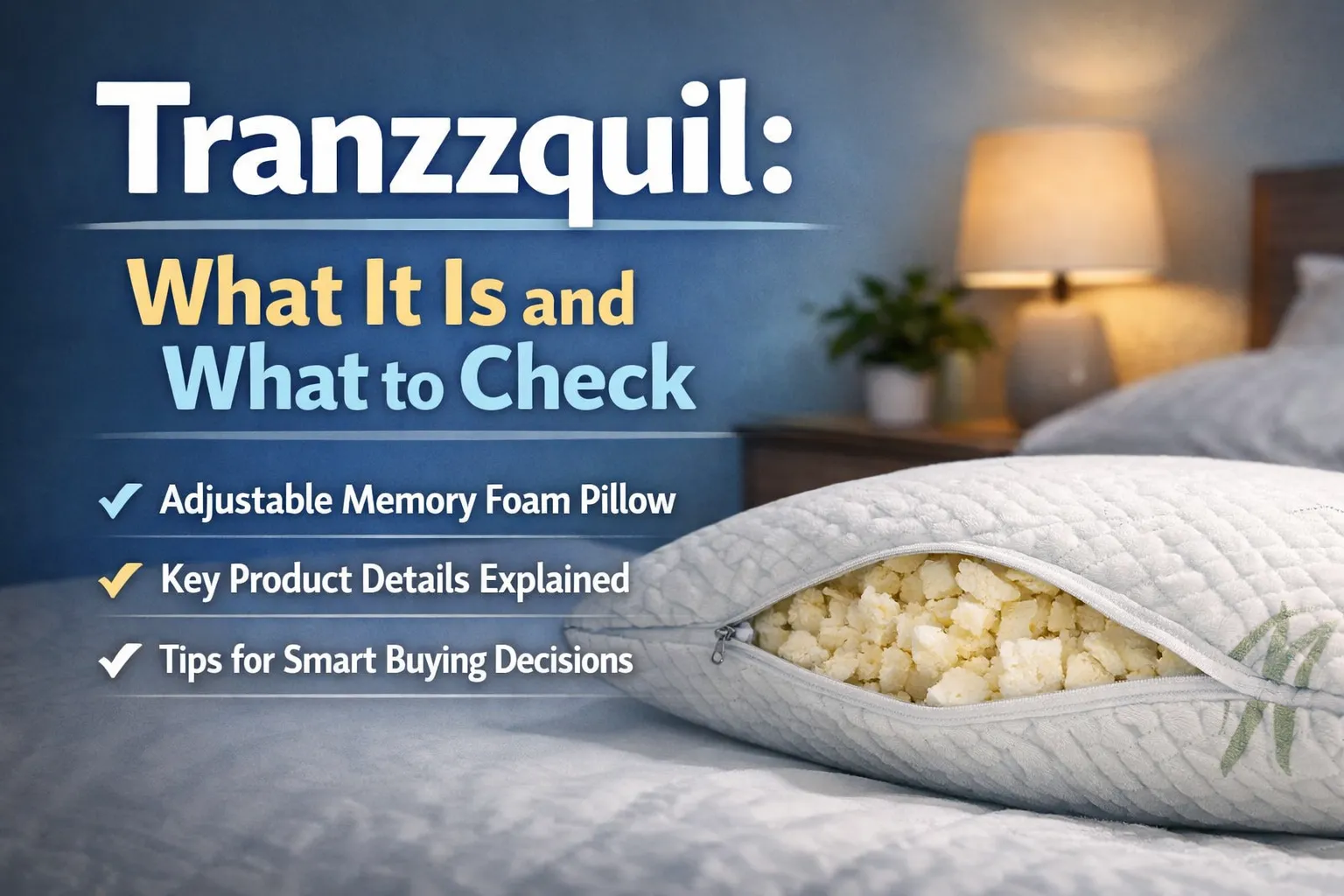
Searches for “tranzzquil” do not point to a broad, well-documented company profile or a widely covered consumer brand. Instead, the clearest public results tie the term to sleep products, especially adjustable memory foam pillows and, in some listings, weighted blankets. That matters because when a name has a limited public footprint, buyers need to focus less on branding and more on what can actually be verified.
For most readers, the real question is simple: is Tranzzquil a meaningful product name you can trust, or just a label attached to a generic sleep item? The best answer is that it appears to be a marketplace-facing product name associated with bedding products, not a brand with a strong, transparent public presence. That does not automatically make it bad, but it does mean you should evaluate the item itself very carefully before deciding to buy.
What Tranzzquil seems to refer to
The most consistent search results connect Tranzzquil with a hypoallergenic shredded memory foam pillow described as adjustable, designed for back and side sleepers, and paired with a bamboo cover. Multiple marketplace-style listings repeat similar product language, which suggests the keyword is being used mainly as a product or seller label in bedding listings rather than as the name of a widely established consumer brand with a strong standalone identity.
Some results also show a Tranzzquil weighted blanket, which broadens the picture slightly. Instead of pointing to one famous hero product, the public web suggests a small sleep-product label or reseller-style brand presence focused on comfort and rest-related goods.
That distinction is important. Many shoppers search a name expecting to find a company website, a reliable “about” page, a clear return policy, or a large body of independent reviews. In this case, the web signal is thinner. You can find product pages and repeated descriptions, but much less public-facing brand context than you would expect from a major bedding company.
Why people search this term in the first place
When unusual product names appear in search, readers are often trying to answer one of these questions:
- What is this product?
- Is it legitimate?
- Is it safe to use?
- Is it worth the price?
- Does it really offer the features listed?
That is the right approach here. With Tranzzquil, the name alone does not tell you much. The buying decision depends more on product construction, certifications, sleep-position fit, return options, and review quality than on brand reputation alone.
The main claims attached to Tranzzquil pillows
Public listings repeatedly present the pillow with a few core selling points: adjustable loft, shredded memory foam filling, a bamboo cover, dust-mite resistance, and suitability for back or side sleepers. Some listings also mention CertiPUR-US foam.
On paper, those claims sound reasonable. Adjustable loft is a useful feature because pillow height affects neck alignment, and different sleep positions need different levels of support. Side sleepers usually need more fill than back sleepers, while stomach sleepers often do better with a much thinner pillow. Sleep guidance from expert-backed sources also emphasizes neutral neck alignment rather than simply choosing the softest pillow available.
The hypoallergenic angle also makes sense in principle. Sleep-focused guidance notes that shoppers dealing with allergies should pay attention to allergen resistance, washable covers, and materials that are less likely to trap irritants.

What the certifications actually mean
One of the more important details in Tranzzquil-related listings is the reference to CertiPUR-US foam. If that foam is genuinely certified, it means the flexible polyurethane foam has been tested against certain content, emissions, and durability standards. CertiPUR-US says certified foams are made without formaldehyde, ozone depleters, certain phthalates regulated by the U.S. Consumer Product Safety Commission, mercury, lead, and other heavy metals, and must meet low VOC emission requirements.
That said, there is a nuance shoppers often miss: CertiPUR-US applies to the foam, not automatically to the entire finished pillow as a whole. In other words, the filling may meet that standard, but that does not by itself verify every other component or every broad marketing claim on the listing.
If a textile component is marketed with OEKO-TEX STANDARD 100, that label means the textile has been tested for harmful substances and meets the certification’s safety criteria. OEKO-TEX describes STANDARD 100 as a benchmark for textile safety from yarn to finished product. Again, though, shoppers should verify that any certification claim is clearly stated and traceable on the actual product listing rather than assumed.
Is Tranzzquil legit?
The safest answer is this: Tranzzquil appears to be a real product label used in public online listings, but the visible web presence is limited compared with large, well-known bedding brands. That means the product name is not imaginary, yet the brand transparency is not especially strong either.
For that reason, “legit” should be judged through evidence you can inspect:
Signs that improve confidence
- Clear product specifications
- Transparent seller details
- Real return and refund information
- Verifiable certification references
- Consistent sizing and fill information
- Balanced customer reviews with both positives and negatives
Signs that call for caution
- Vague claims with no detail
- Repeated marketing language copied across many sites
- No meaningful seller identity
- No warranty or unclear return terms
- Review patterns that feel unnatural or overly uniform
- Health claims that go beyond normal comfort or support language
This matters because some listings use ambitious wording such as relief for insomnia or chronic pain. Comfort products can help some users feel better supported, but sweeping health outcomes should always be treated carefully unless backed by stronger clinical evidence tied to that specific product.
What matters most if you are thinking about buying it
If you are evaluating a Tranzzquil pillow, four checks matter more than the brand name itself.
1. Fit for your sleep position
Back and side sleepers often benefit from adjustable pillows because they can fine-tune the loft. Stomach sleepers usually need something lower and flatter to avoid pushing the neck into an awkward angle. If you sleep hot, firmness and fill density also matter because some foam products can trap more warmth than lighter alternatives.
2. Materials and washable components
A removable, washable cover is practical, especially for people sensitive to dust, sweat, or allergens. If the listing highlights bamboo fabric, hypoallergenic materials, or dust-mite resistance, that can be useful, but the real benefit depends on whether the cover is washable, how the pillow is maintained, and whether the construction matches your needs.
3. Certification clarity
Do not stop at seeing a certification name in the bullet points. Look for whether the listing clearly identifies what is certified. Foam certification and textile certification are not the same thing, and they do not verify every claim a seller makes.
4. Review quality, not just star averages
Mixed reviews are not always bad. In fact, they can be more useful than perfect-looking ratings because they reveal whether common complaints involve odor, lumpiness, firmness, or size. Product pages tied to Tranzzquil-style listings show the kinds of trade-offs buyers often report with foam pillows: some users praise comfort and support, while others complain about smell, inconsistent fill, or disappointing texture.
Read must: Understanding Tribupneu in Simple Terms
A quick comparison: what the keyword tells you vs what actually matters
| What people may assume from the search | What you should really check |
|---|---|
| It is a well-known, highly documented bedding brand | Whether the seller, return policy, and product details are clearly visible |
| “Hypoallergenic” means it will solve all allergy issues | Whether the cover is washable, the materials are suitable, and the pillow is maintained properly |
| “CertiPUR-US” means the whole pillow is certified | Whether the certification applies only to the foam or to another specific component |
| “Adjustable” means it will suit everyone | Whether your sleep position and support needs match the pillow’s loft range |
That is usually the difference between a confident purchase and a frustrating one. The keyword alone is only a starting point. The buying decision should come from evidence.
Common misunderstandings around terms like Tranzzquil
“If it shows up in search results, it must be a major brand”
Not necessarily. Many product names gain search visibility through marketplace listings, reseller pages, and reposted catalog data rather than through a strong direct-to-consumer brand presence. That appears to be part of what is happening here.
“Memory foam is always better”
Memory foam can work well for support and contouring, but it is not automatically the best choice for everyone. Some sleepers dislike the feel, some notice odor when a foam pillow is first opened, and others find certain fills too dense or too warm.
“Hypoallergenic means medically proven”
The term is useful, but it is often broader than consumers think. It generally signals reduced likelihood of triggering allergies, not a guaranteed medical outcome for every sleeper. The practical features behind the label matter more than the label itself.

Practical checklist before you decide
If you are considering a Tranzzquil pillow or a similar product, check these points before buying:
- Confirm pillow size and loft options
- Make sure the cover is removable and washable
- Verify what any certification actually covers
- Read recent reviews for odor, lumpiness, and durability
- Check whether back, side, or stomach sleeping is specifically supported
- Look at return timing and whether opened bedding can be returned
- Be cautious with exaggerated health claims
- Compare the price against other adjustable memory foam pillows with clearer brand transparency
This kind of checklist is especially important when a product label has limited public context. It helps you judge the item on evidence instead of packaging language.
What matters most
If you remember only one thing, make it this: “tranzzquil” appears to be a sleep-product keyword tied mainly to adjustable memory foam pillows and related bedding items, not a deeply documented household brand. That does not rule it out, but it does change how you should evaluate it. Focus on verified materials, support for your sleep position, certification details, seller transparency, and real customer feedback.
Conclusion
Tranzzquil looks like a real market-facing product name, most closely associated with memory foam pillows and some other sleep products. The public web offers enough evidence to identify the category, but not enough to treat it like a highly transparent major brand. That means careful product-level evaluation matters more than the name itself. If the materials, support profile, certification details, and return terms hold up, it may be worth considering. If those details are vague, it is smarter to keep looking.
FAQ
Is Tranzzquil a pillow brand or a general term?
Public search results most strongly connect Tranzzquil with branded or seller-labeled sleep products, especially adjustable shredded memory foam pillows, rather than with a general dictionary word or a broad lifestyle topic.
Is Tranzzquil safe to use?
No public source found here shows a broad safety warning specific to Tranzzquil products. But safety should be judged through material details, seller transparency, proper certification claims, and normal bedding care rather than through the name alone.
What does adjustable loft mean in a pillow?
It means the amount of fill can usually be changed so the pillow sits higher or lower. That matters because different sleep positions need different neck support and alignment.
Does CertiPUR-US mean the whole pillow is certified?
No. CertiPUR-US applies to flexible polyurethane foam, not automatically to the entire finished pillow. Buyers should check exactly which component is certified.
Who is most likely to benefit from a product like this?
Based on the public descriptions, back and side sleepers are the clearest target users. Stomach sleepers often need a thinner option, so they should be more careful before choosing this style of pillow.
